
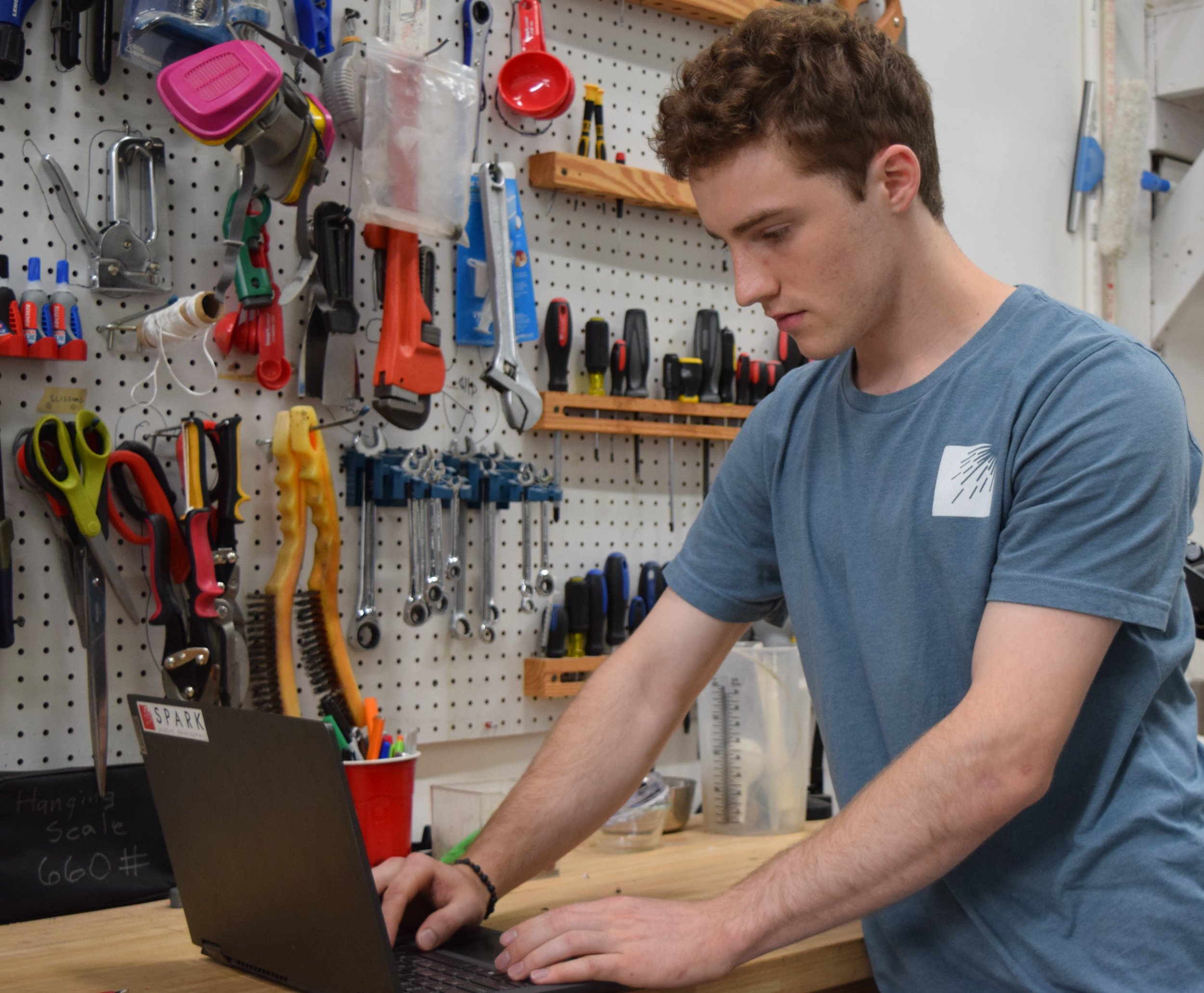
When Will Knutson arrived at SPARK at the beginning of the summer, he already knew how he would approach his internship:
Intentionally.
That had been a pattern long before his first day. Will originally approached SPARK about an internship while still in high school. When SPARK co-owner Shane Diller told him he needed more engineering experience first, he then approached with a list of classes he was taking over the next year, asked which would be the most useful, and what other skills he should learn in his own time. He even kept Shane updated on his progress and eventually returned with a portfolio.
By the time he joined SPARK after his first year at Georgia Tech, Will was still early in his engineering education, but he was already very good at seeking opportunities to learn. Over the course of the summer, his intentional approach evolved into something more: the confidence to step into a problem he knew little to nothing about and begin figuring it out.
“I’ve had very little experience with FEA, thermodynamics, and fluid flow and now because of SPARK, I am much more comfortable with them and that is just to name a few. But what really stands out is I have learned how to learn quickly about something I know nothing about.”
For Will, that may be one of the most important things SPARK gave him.
And his willingness to do so is one of the most important things he brought to SPARK.
Learning Without Waiting to be Taught
At SPARK, Will found himself moving between projects, technical disciplines and stages of product development, sometimes several times in the same day.
He gained exposure to CAD, finite element analysis, thermodynamics, fluid flow, injection molding, sheet metal forming and manufacturing documentation. But the larger lesson wasn't simply adding technical skills to his resume.
It was learning what to do when he didn't already have the skill he needed.
Shane noticed that early.
“Will was very good at gathering resources that were not immediately at his fingertips,” Shane said. “He did not wait for somebody to present him with all of the information before he could start a task.”
Will also sought knowledge from the people around him. He paid attention to conversations happening across the office and would ask to listen in if there was something he could learn.
That worked particularly well at SPARK because expertise isn't treated as something to gatekeep.
Will described a culture where people were willing to meet him at his current level of understanding and explain a subject fully. Will said this about his work with Jon Kyte and Chris Murray about industrial design, and Fred Dewees about electronics:
“There is so much to take away from SPARK, I’d have to work here for a lifetime to tap into the expertise. I have had to intentionally choose what knowledge I walk away with”
He continued by highlighting his enjoyment in working with Fred, saying, “He is so great at non-judgementally taking me from knowing nothing to knowing exactly what I need to know and sometimes even a little more.”
SPARK also values what the team calls “friction”: people bringing different ideas about how a problem should be solved, questioning one another's assumptions and defending their reasoning.
Will stated, “I even like that the intern got to take part in that friction. It feels very collaborative to get towards the best way to solve a problem.” He could disagree with someone who had significantly more engineering experience than he did, while still understanding that the conversation wasn't about proving who was right. It was about finding the strongest solution.
That environment helped move him away from what he called a “school mindset.”
Will stated, “Sometimes the best engineering decision isn't the most technically elaborate one. A design may work but require unnecessarily tight tolerances. One complicated component might be better approached as two simpler ones. A custom part may be unnecessary when an off-the-shelf solution already exists.”
Shane describes this as knowing when a design has become “too cute.”
It is the kind of judgment that rarely comes from a textbook. It comes from seeing how engineering decisions interact with manufacturing, cost, usability and the larger needs of a project.
Bringing New Questions to SPARK
Will's internship wasn't only about absorbing knowledge already inside the office. He was also asked to investigate an area SPARK itself is continuing to explore: artificial intelligence.
Part of his work involved testing how AI could support research and internal workflows without replacing the human judgment behind them. Will found it especially useful for narrowing large bodies of information and identifying where deeper research should begin.
He also experimented with methods for improving reliability, including more specific instructions, requiring citations and asking the system to identify uncertainty.
But his work reinforced an important distinction: AI could help him get to information faster. It couldn't eliminate the need to understand what he was looking at.
In that sense, the assignment reflected the larger skill Will was developing all summer. You don't have to know everything before you begin. You do have to know how to learn, what to question and when to bring expertise into the process.
Seeking Feedback, Not Just Experience
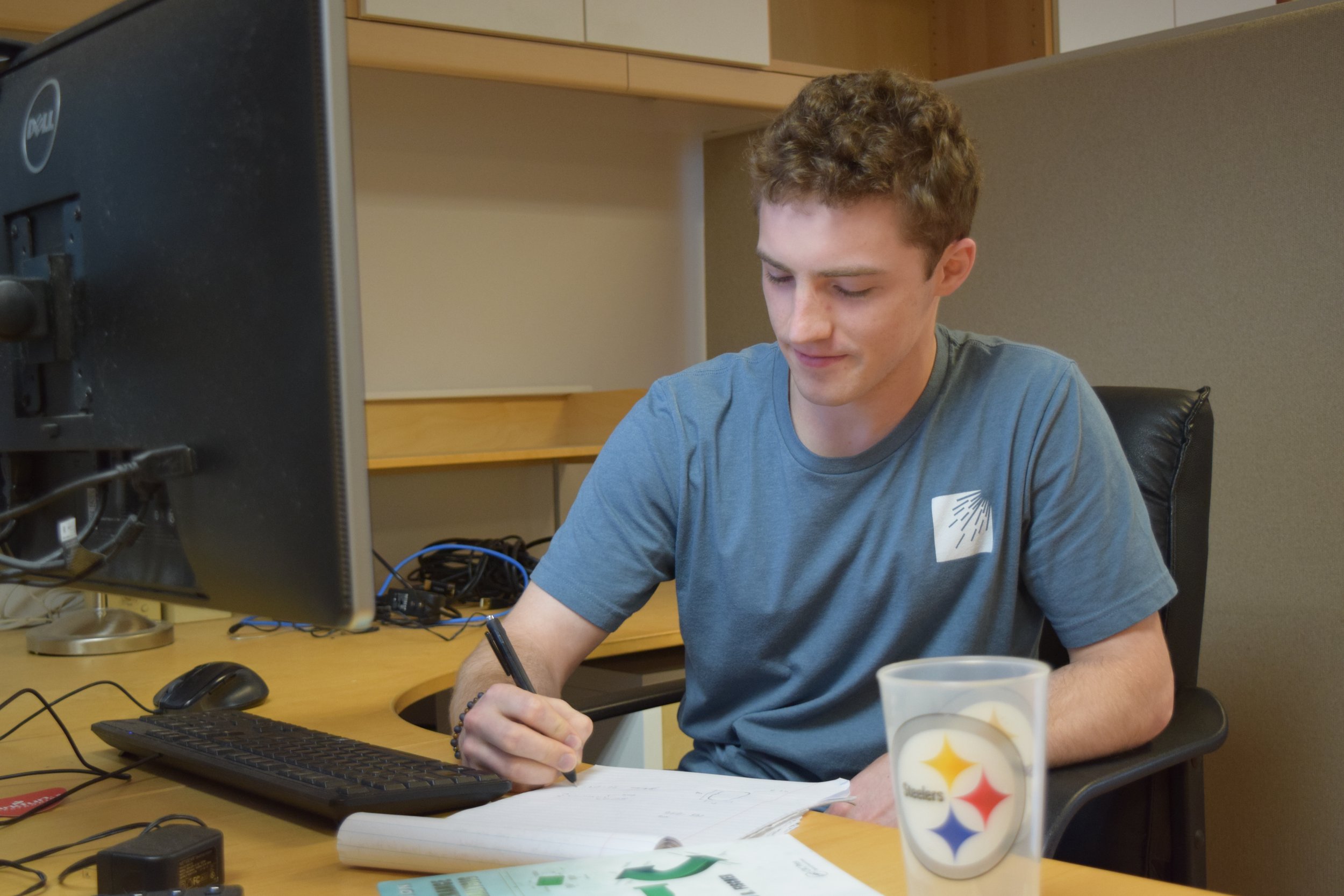
Perhaps the clearest example of Will's approach to his internship came from something unusual he asked Shane to do. Will requested biweekly performance check-ins. Then he asked Shane to gather feedback from the entire office.
“That's the first time anybody has ever asked that,” Shane said. “I've never met somebody so hungry for feedback.”
At one point, Shane joked that Will seemed to be in a rush to achieve some future goal.
Will pushed back, “The journey is the goal.” A perfect response to explain why Will fit so naturally with SPARK’s culture.
He arrived wanting exposure to engineering beyond what he could get in a classroom. He’s leaving with stronger technical skills, a clearer interest in mechanical engineering and a much better understanding of how professional product development works.
But perhaps more importantly, he leaves more comfortable entering the unfamiliar.
Will’s advice to any future SPARK intern:
“Start with what you don't know. Ask questions. Listen to different ideas. Defend your reasoning. Be willing to change direction. Then keep learning.”